TEE/TTE Workshop
Program Description
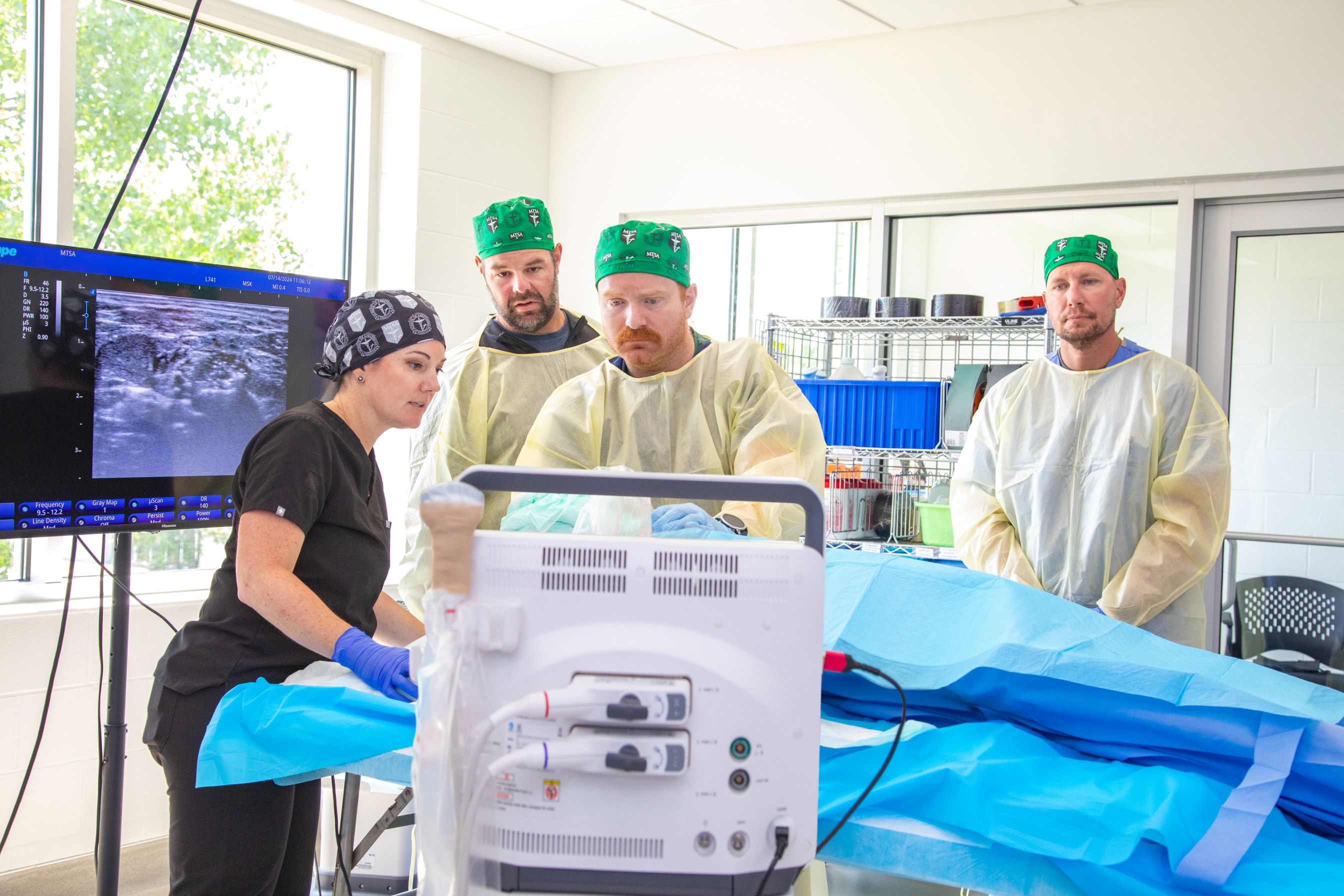
The TTE-TEE Point-of-Care Workshop is designed to introduce the participants to studies that can be used as part of patient assessment in everyday clinical practice. This program is being held to enhance the clinical skills of healthcare providers, enabling them to incorporate TTE and TEE into their perioperative assessments, ultimately improving patient outcomes. Participants must complete the TTE/TEE Online modules prior to attending the workshop. During the workshop, participants will learn to perform the studies on live models and high-fidelity simulators.
Workshops are scheduled from 7:30 am to 12:00 pm.
Location: Middle Tennessee School of Anesthesia
Target Audience: CRNAs & RRNAs
Disclosures: Individuals involved in the planning, reviewing or execution of this activity have indicated they have no relevant financial relationships to disclose.
Cancellation Policy: To better accommodate the high demand for our courses and minimize the need for refunds, we kindly request that you provide us with as much advanced notice as possible.
If you are unable to attend the workshop, you may transfer to another workshop.
- A fee of $95 will be charged to transfer to a different workshop date if rescheduled more than 6 weeks prior to the original workshop date.
- A fee of $150 will be charged to transfer to a different workshop date if rescheduled less than 6 weeks prior to the original workshop date.
If you cannot attend a different course, we will issue refunds at the following rates:
- 8 weeks prior to the workshop: 80% refund
- 6-8 weeks prior to the workshop: 50% refund
- Less than 6 weeks prior to the workshop: No refunds, but you may transfer to another scheduled workshop for a fee of $150.
Questions? Contact us at ce@mtsa.edu
1. Participants will need a computer and an internet connection sufficient for streaming media for the online educational modules.
2. Navigate to Brightspace learning management system
3. Create a username and password
4. Choose the TTE-TEE Workshop you would like to attend
1. Online Content: Focused Cardiac Ultrasound for the Non-Cardiac Patient
- TTE-FoCUS Lecture
- Ultrasound Assessment of the IVC Lecture
- Inferior Vena Cava Ultrasonography for Volume Status Evaluation Article
- Post-Test
2. Online Content: Focused Cardiac Ultrasound for the Non-Cardiac Patient
- Focused TEE for the Non-Cardiac Patient Lecture
- Basic Perioperative Transesophageal Echocardiography Examination: A Consensus Statement Articles
- Perioperative transesophageal echocardiography for non-cardia surgery Article
- The Effect of Perioperative Rescue Transesophageal Echocardiography on the Management of Trauma Patients Article
- Use of Rapid “Rescue” Perioperative Echocardiography to Improve Outcomes After Hemodynamic Instability in Noncardiac Surgical Patients Articls
- TEE Post-Test
3. Learner Assessment
These modules must be completed prior to the hands-on workshop. The online content is self-paced and include presentations with visuals and audio.
The in-person workshop will offer you valuable practical experience through live models and high-fidelity simulations. It's a crucial component of your learning journey and an opportunity to apply the knowledge gained from the online modules.
The post-test and learner self-evaluation will remain locked until the learning modules are completed. All online activities must be completed prior to the hands-on workshop.
Workshops are from 7:30 am to 12 pm.
To receive 12 CE credits and your certificate of completion, please ensure the following:
- Completion of all online educational modules
- Achieve a minimum score of 80% on the post-test (with two attempts allowed)
- Attendance of the 4-hour hands-on workshop
- Completion of the Workshop Learner Assessment
The certificate of completion is available for download once all requirements have been met. The certificate is also emailed to the learner’s email entered in their ispringmarket account.
Module I: Online Content: Focused Cardiac Ultrasound for the Non-Cardiac Patient
- Compare and contrast the FOCUS exam to transesophageal echocardiogram
- Review ultrasound principles specific to cardiac imaging
- Discuss indication for performing a FOCUS exam
- Explain the scanning technique to obtain the following views:
- Parasternal Short-Axis
- Parasternal Long-Axis
- Apical Four Chamber
- Subcostal
- List the criterial of a normal FOCUS exam
- Review the procedure to assess fluid volume status through ultrasound imaging of the inferior vena cava (IVC)
- Determine the fluid volume resuscitation requirements based on IVC assessment
Module II: Online Content: Focused Transesophageal Echocardiography for the Non-Cardiac Patient
- Compare and contrast the Focused Transesophageal Echo (TEE) Exam to the Focused Transthoracic Echocardiography Exam (TTE)
- Identify key TEE probe and “knob” considerations necessary for performing focused transesophageal echocardiography
- Describe the scanning technique to obtain the following TEE views:
- Midesophageal Four Chamber, Long Axis Views and Aortic Valve Short Axis
- Midesophageal Ascending/Descending Aorta and Bicaval
- Transgastric Short Axis
- Review the procedure to assess volume status and contractility through ultrasound imaging of the left ventricle using the transgastric short axis view
- Describe the role of Focused TEE in identifying reversible pathologies such as tamponade and dissection
- Determine the appropriate hemodynamic intervention based on fluid and contractility assessment using Focused TEE
- Describe common artifacts encountered during TEE assessments
Module I: Hands-On: TTE Assessment
- Compare and contrast the scanning techniques and clinical application between a FOCUS exam and a TEE exam
- State the indications for performing a FOCUS exam
- Identify criteria of a normal FOCUS exam
- Practice obtaining high-quality images of the following FOCUS views on live models:
- Parasternal Short-Axis
- Parasternal Long-Axis
- Apical Four Chamber
- Subcostal
- Perform an ultrasound assessment of the inferior vena cava (IVC) to determine fluid volume status, including measuring IVC diameter and assessing respiratory variation.
- Identify abnormal findings necessitating expert consultation
Module II: Hands-On: TEE Assessment
- Demonstrate proper handling of the TEE probe, including insertion, manipulation, and adjustment of imaging controls (“knobology”) to optimize image quality in various TEE views.
- State the indication for performing a TEE exam
- Acquire the following TEE views using the intelligent ultrasound simulator:
- Midesophageal Four Chamber, Long Axis Views, and Aortic Valve Short Axis
- Midesophageal Ascending/Descending Aorta and Bicaval
- Transgastric Short Axis
- Interpret the views for key clinical indicators, including volume status and contractility
- Assess and identify reversible pathologies (e.g., tamponade, dissection) using TEE imaging and determine when interventions are necessary based on findings
- Identify common artifacts encountered during TEE assessments and demonstrate techniques to minimize or correct these artifacts
Available editions:
| Product Name | Date | Location | Delivery Method | Price | |
| November 16, 2026 TEE/TTE Workshop | 2026-11-16 | Online | Workshop | $599.00 |